Planning to Pivot

Narrative profile is part of a companion series to the Reimagining Military Spouse Employment research initiative. While the data briefs provide statistical analysis of employment patterns, industries, and outcomes, this series puts a human face on the data by following military spouses through the career pivots the research describes.

The profile follows a new military spouse as she navigates early career disruptions, PCS moves, and the compounding effects of short-term decisions on long-term career outcomes. It is written for a dual audience: military spouses seeking practical insight, and employers and policymakers looking to understand the lived experience behind the data.

This research is funded in part by USAA. The contents of this publication are solely the responsibility of the authors.

The Facts

Financial impact

Lost earnings: 

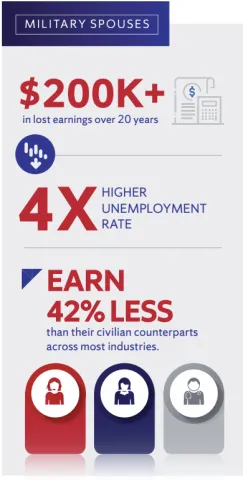
$200K+ over a 20-year military career

After relocating: 

32% income drop after a PCS move

Wage gap: 

42% less earned compared to civilian counterparts

Employment barriers

Unemployment: 

4x higher unemployment rate than civilian counterparts

Job search:

29 wks average job search time after a PCS move

Field mismatch:

28% end up working outside their field

Workforce participation

Out of workforce:

31% are out of the workforce entirely

Retention:

22% maintain full-time employment over 3 years

Underemployment:

70% of working spouses are underemployed

What Military Spouses and Employers Should Know

How Employers Can Help with Early Career Pivots

Image
Military Spouses Early Pivot: The Challenge; adjacent text provides details.

 The Challenge

  • 4x higher unemployment rate than civilians.
  • 29 weeks to find a job on average.
  • 32% income drop after relocating.

Military spouses: Early Career Decisions

There is no PCS-proof career field. No matter how in-demand a career field, military-directed PCS moves force a career pause. Once you understand that, you can start minimizing downtime. Pursue remote work, start job hunts in future duty stations earlier, and focus on career development so your credentials offset a patchwork resume.

Employers: Understanding The Applicant

A military spouse’s professional and educational background may not align, but it is not because of a lack of direction or vision. In our dual-income society, military spouses are often forced to take jobs rather than build careers.

Actions

  • Train AI and applicant tracking systems not to automatically exclude military spouse candidates. Resume gaps and short tenures are structural, not performance indicators.
  • Train recruiters and HR professionals on military cultural competence so they understand why resumes feature frequent relocations, employment gaps, or underemployment.
  • Provide hiring managers with a toolkit to identify and evaluate military spouse candidates fairly.

How Employers Can Help with Family Pivots

Image
Military Spouses Family Pivot: The Challenge; adjacent text provides details.

The Challenge

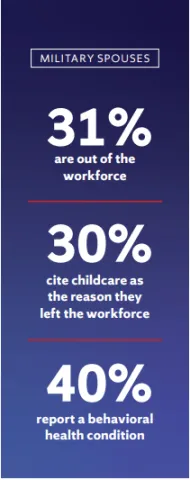
  • 31% of spouses are out of the workforce.
  • 30% cite childcare as the reason; childcare costs exceed college tuition in most states.
  • 40% report a behavioral health condition.

Military Spouses: Leaving the Workforce

Stepping back from paid work can be the right decision for your family, but it carries real economic and professional costs. Social Security earnings, savings, and career momentum all take a hit. It was a family decision, but the costs are rarely distributed equally.

Employers: Childcare and Flexibility

Military spouses hold up the home front. That means being on call for sick kids and when childcare falls through. Flexible work schedules and remote options are not just nice to have. Without them, it becomes significantly harder for military spouses to stay in the workforce.

Actions

  • Offer job portability, not just remote work, but the ability to transfer within the company during a PCS move.
  • Develop remote options and intentionally designate positions for remote work.
  • Provide childcare support through on-site options, subsidies, or tax benefits to offset costs.

How Employers Can Help with Reentry Pivots

Image
Military Spouses Re-entry Pivot: The Challenge; adjacent text provides details.

The Challenge

  • Military spouses earn 42% less than civilian counterparts.
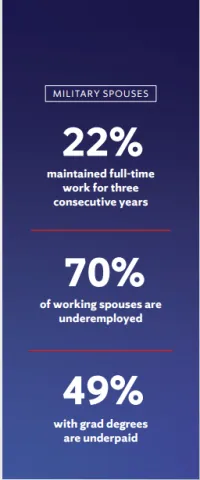
  • 70% of working spouses are underemployed.
  • Only 22% maintain full-time work over 3 years.

Military Spouses: Coming Back to Work

Stepping away from the workforce does not mean you were not invested in your career. When you come back, expect that it may feel like starting over, and plan for it. The income gap between military spouses and civilian peers actually grows with advanced degrees. Know that before you invest.

Employers: Invest In Advancement

Our patchwork resumes are not evidence of instability. They are evidence of ingenuity. Invest in mentorship, create pathways for advancement, and build roles that do not disappear when we move. That is not just patriotic. It is an investment in a highly skilled, adaptable workforce that is too often overlooked.

Actions

  • Shift focus from hiring to advancement through mentorship, leadership programs, and remote advancement tracks.
  • Build leadership pathways that help military spouses move beyond entry-level roles.
  • Offer mentorship programs. Mentorship increases the odds of sustained employment by 83%.

About The Series

This narrative profile is part of a companion series to the Reimagining Military Spouse Employment research initiative. While the data briefs provide statistical analysis of employment patterns, industries, and outcomes, this series puts a human face on the data by following military spouses through the career pivots the research describes.

A woman wearing a blazer holds a mic while speaking to a person out of frame. The other attendees are focused on the suited woman.

Planning to Pivot

A new military spouse navigates early career disruptions, PCS moves, and the compounding effects of short-term decisions on long-term career outcomes.

A woman poses for a photo holding two prop signs reading "#CEO" and "#Military Spouse" in front of a Syracuse IVMF CEOCircle JP Morgan Chase wall.

The Accidental Entrepreneur

A mid-career military spouse confronts childcare barriers, compounding setbacks, and the decision to build something of their own.

A group of 3 panelists sit on tall stools in front of a crowded room while the session host addresses the MilSpouse Summit 2023 crowd.

To Stay or To Go

A discouraged worker weighs whether to exit the workforce entirely, and what that choice means for identity, finances, and family.

Suggested Citation

Barnhill, J., Maury, R.V., and Harvie, J.Y. (2026). Planning to Pivot: Employment Lessons from a New Military Spouse. Syracuse, NY: D’Aniello Institute for Veterans and Military Families, Syracuse University.

This research is funded in part by USAA. The contents of this publication are solely the responsibility of the authors.