
In 1783, as the United States was in the early stages of forming the central government after almost a decade fighting for its freedom, George Washington stood before his officers and insisted that the nation honor its debt to the men who built it. Less than 200 miles from Syracuse University, along the Hudson River in New York’s Hudson Valley, Washington confronted a question that would outlive the Revolutionary War itself: What does a nation owe the people who serve it? More than two centuries later, that question remains at the center of veteran policy, military family support, and the ongoing work of helping those who serve successfully transition into civilian life.
The American republic was barely an idea when George Washington first fought for the people
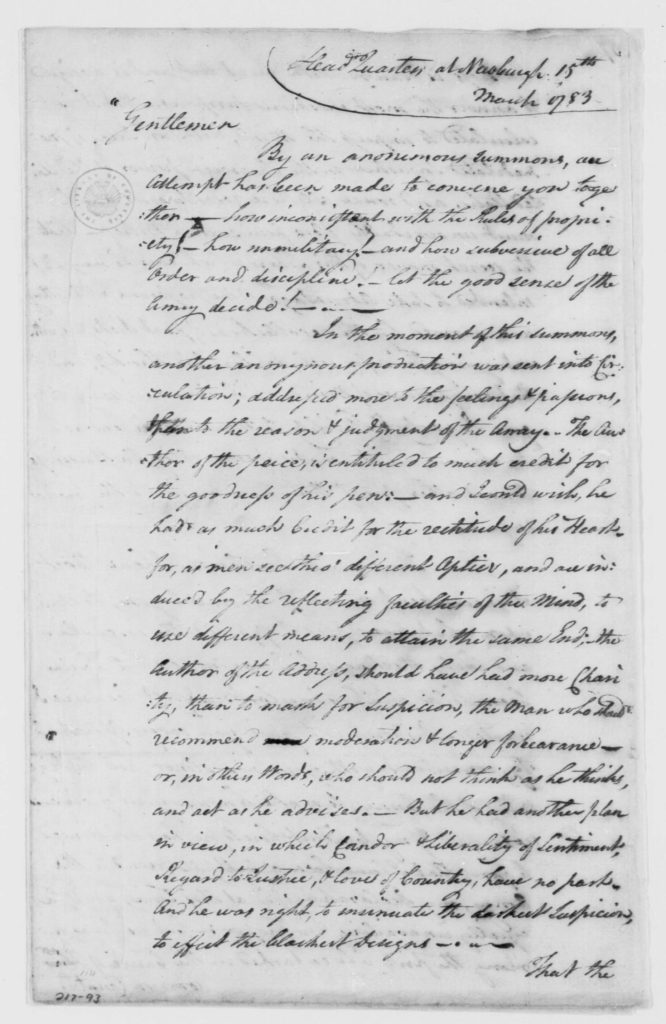
The Newburgh Address, given by George Washington on March 15, 1783.
Source: Library of Congress
who fought to make it possible. The war was effectively over, Cornwallis had surrendered at Yorktown in October 1781, peace negotiations were underway in Paris. In the winter encampment at Newburgh, New York, however, the men who had won that war were still waiting: unpaid, unrecognized, and unsure whether a grateful nation was more than a phrase.
On March 10, 1783, an anonymous letter began circulating through the officers’ quarters. It gave voice to a real grievance: Congress had failed to deliver back pay, settle accounts, or make good on promised pensions. The letter’s author, later attributed to Major John Armstrong Jr., urged the officers to take matters into their own hands. If the war continued, abandon the field. If peace came, refuse to disband until demands were met.
The threat was not rhetorical. It was a mutiny in waiting.
What does a nation owe the people who serve it?
Washington called his own meeting for March 15. What happened in that hall has become one of the defining moments in American military history, not because of what Washington argued, but because of how he argued it.
Washington did not dismiss his officers’ frustrations, he shared them. He had written letter after letter to Congress on their behalf. He had watched men go without pay, without adequate provisions, without the basic acknowledgment their service had earned. When he finished his own prepared remarks, he began to read a handwritten letter from a Virginia congressman to provide proof of Congress’s good-faith intent. Washington fumbled for his spectacles, put them on, and told the room he had, “grown gray in their service and was now going blind.”
The officers reportedly wept, and what became known as the Newburgh Conspiracy collapsed. The officers voted unanimously to reject the anonymous addresses and asked Washington to press their case through Congress rather than against it, a request Washington feverishly advocated for until Congress agreed to five years of full pay to officers in lieu of their promised pensions.
What Washington established at Newburgh was not just a resolution to an immediate crisis, it was a framework of good governance. The nation owed something to the people who served it. That debt was real, not ceremonial. While the institutions of government were slow to recognize it, the lapse in judgement was a failure of those institutions, not a reason for those who served to stop expecting better.
The significance of that moment extended beyond military officers and pension disputes. Washington established an expectation that service creates an enduring obligation between citizens and their government. While the institutions charged with fulfilling that obligation would evolve dramatically over the next two centuries, the principle itself would remain remarkably consistent.
Every War is Outlived by its Debt to Those Who Fight it.
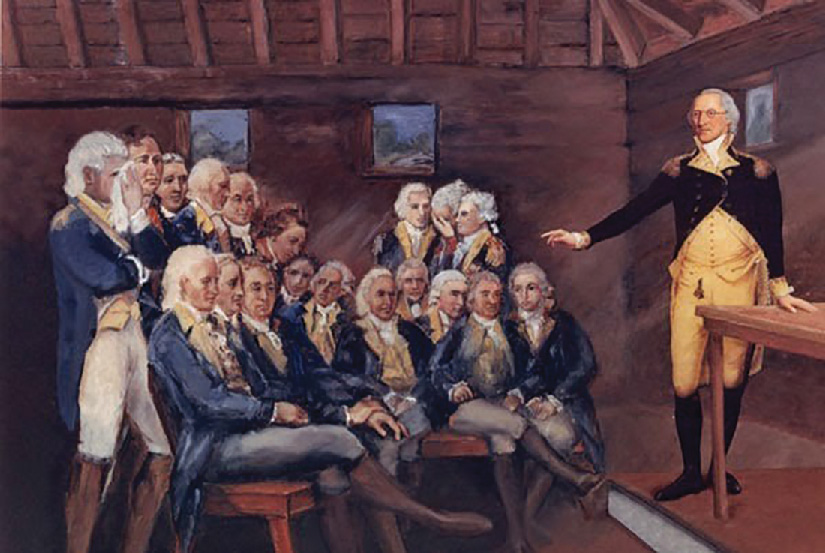
A painting of George Washington addressing the troops at Newburgh, NY, by Jane Sutherland,
Source: Courtesy of George Washington’s Mount Vernon
The specific grievances at Newburgh, unpaid wages, unfunded pensions, a Congress that moved too slowly to honor what it had promised, would echo through every subsequent generation of American veterans. The Civil War produced pension fights that consumed congressional debate for decades. The soldiers of World War I came home to a bonus promised and then denied, until a 1932 march on Washington ended in federal troops clearing veterans from the National Mall at bayonet point. Even as the nation began to collectively learn about supporting those who fight for its causes, not all returning veterans from World War II were able to access the benefits made available to them.
Washington understood something that took the country another century and a half to fully institutionalize: the transition from military service to civilian life is not an individual challenge. It is a national one. The men at Newburgh had not failed to plan for peace, they had served in a structure that offered no plan at all. The problem was systemic, and the solution had to be systemic too.
The transition from military service to civilian life is not an individual challenge. It is a national one.
Nor is it a challenge borne by veterans alone. Military spouses, caregivers, and children often navigate the consequences of transition alongside the service member. Economic mobility, career opportunities, housing stability, access to healthcare, and community connection influence not only individual veterans but entire military families. The obligation Washington articulated reaches beyond those who wore the uniform to those who served alongside them in less visible ways.
More than two centuries later, Syracuse University’s D’Aniello Institute for Veterans and Military Families (IVMF) was founded on that same premise. Successful transition cannot depend solely on individual resilience. It requires systems, institutions, and communities working together to create pathways for opportunity. Through research, policy engagement, workforce development, entrepreneurship programs, and coordinated community services, the D’Aniello Institute works to strengthen the infrastructure that helps veterans and military families thrive after service.
Lessons of Yesterday Fuel Today’s Advocacy
Founded in 2011, the IVMF was built on a deceptively simple idea: that the skills, experience, and drive veterans bring home from service are genuine economic assets, and that the gap between those assets and realized opportunity is not inevitable. It is addressable. The Institute exists to address it.
None of that happens without the underlying conviction that Washington articulated in 1783: that service creates obligation, and that obligation requires institutions to meet it.
That work reflects Syracuse University’s longstanding commitment to serving the veteran and military-connected community through education, research, and public engagement. In many ways, the questions explored at Newburgh remain the same questions confronting policymakers, employers, educators, and community leaders today: how to recognize military service not only with gratitude, but with meaningful opportunity.
IVMF’s research has documented, across thousands of cases, the factors that determine whether a veteran’s transition succeeds or stalls: access to career training, connection to employer networks, navigation of community services, and the foundational economic stability that makes everything else possible. These are not soft concerns. They are measurable, consequential, and responsive to intervention.
The Onward to Opportunity program, available on 20 military installations and online, has trained more than 100,000 service members, veterans, and military spouses in the professional certifications employers are actually hiring for. The Entrepreneurship Bootcamp for Veterans has produced graduates whose businesses generate more than $194 million in average annual revenue. AmericaServes, the coordinated community care network the IVMF originated, operates across 18 communities and has connected nearly 50,000 military-connected Americans to the services they need.
None of that happens without the underlying conviction that Washington articulated in 1783: that service creates obligation, and that obligation requires institutions to meet it.
What the 250th Asks of Us
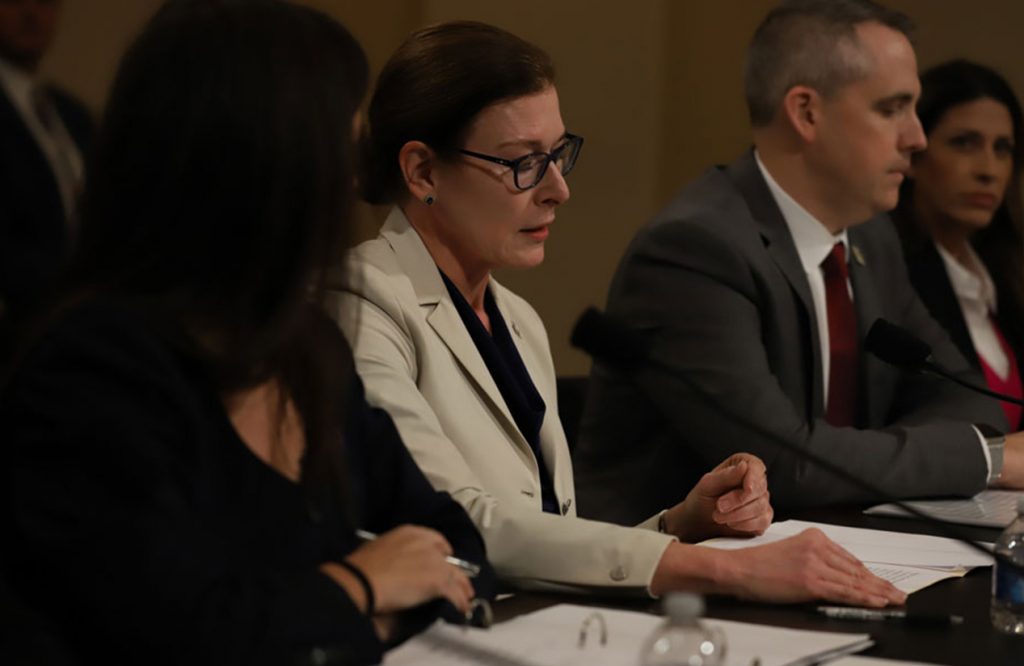
Managing Director of Programs and Services at the D’Aniello IVMF, Barb Carson, speaking before the Senate Committee on Veterans Affairs for the benefit of the veteran community.
A nation’s 250th birthday is an occasion for honest accounting as much as celebration. The question worth asking in 2026 is not whether America has honored Washington’s founding framework in principle. It has, repeatedly and in law. The question is whether it honors that framework in practice, for every veteran, in every community, in every stage of life after service.
The answer, as IVMF research has consistently documented, is that we’re closer than we were and farther than we should be. Roughly 200,000 service members transition out of the military every year. The infrastructure designed to support that transition, federal programs, nonprofit partners, employer networks, community services, is more robust than anything Washington could have imagined in 1783. It is also more fragmented, inconsistent, and uneven in its reach than a 250-year-old obligation deserves.
Meeting that obligation requires more than government action alone. Employers who recognize military talent, universities that invest in veteran success, nonprofit organizations that coordinate services, and local communities that welcome military families all play a role. The responsibility Washington defended has become a shared national undertaking.
Washington’s legacy at Newburgh is not a historical footnote. It is a living standard. He stood before men who had given everything and told them, in effect, that their country owed them more than gratitude. Two hundred and forty-three years later, the work of making good on that argument continues.
This is Part I of a four-part series published by the D’Aniello Institute for Veterans and Military Families at Syracuse University in recognition of the 250th anniversary of the United States. The series traces the legislative and political history of American veteran policy from the founding era to the present day.