The United States of America turns 250 this year. Across American history, Americans who served their country tend to come home and build things. Sometimes great things. They often do this with nothing more than the skills acquired during their service. IVMF strives to create an environment where every veteran and military spouse has the knowledge, tools, and network to succeed in their post-service businesses and careers instead of going it alone.
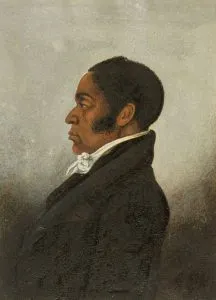
James Forten is one of the original American veteran entrepreneurship stories. He was a free Black teenager in Philadelphia when the country declared independence, and he went to war as a privateer before the law would let him do much else. He came home, learned the sailmaker’s trade, and built one of the most successful businesses in the city, as a Black man, in a nation that still enslaved most people who looked like him.
James Forten (1766-1842)
James Forten grew up doing odd jobs at Robert Bridges’ Sail Loft, where his father worked. Unfortunately, his father died in a boating accident when James was only nine years old, and it fell to James to drop out of the Quaker-run African school to support his mother and older sister. He continued to work at the sail loft off and on, between working as a chimneysweep and grocery store clerk.
James was a patriot, and even at nine years of age believed that as a Black man, he’d fare far better under those vying for colonial independence than under the crown. While he didn’t help write or sign the Declaration of Independence, he was present to hear the informal reading behind Independence Hall on the 4th of July 1776. In the fall of 1777, James endured as the British seized Philadelphia for nine months, turning Independence Hall into a makeshift prison.
Privateer of the Revolutionary War
James wanted to serve, but as a Black child, options of the day were limited. Because of his age, he needed to get his mother’s permission, and James argued passionately in his belief in the promise of an American egalitarian society that judged a man based on his skill, work, and character, rather than the color of his skin or history of his bloodline. In the end, she relented.
Ultimately, it was James’ experience in the sailmaker’s loft with his father that would earn him a billet in 1780, one of only twenty African Americans among the 200-man crew. James Forten served as powder boy on the Royal Louis, a 22-gun privateer vessel under Captain Stephen Decatur Sr. The powder boy’s job was to run cartridges of black powder from the powder magazine belowdecks to the cannons on the gundecks. James reportedly filled several other roles on the ship, and likely would have spent a lot of time aloft in the rigging, learning intimately the nature of how sails interact with the wind, knowledge that would serve him well later in life.
During James’ first cruise, the British held the ports of New York and Charleston, but the waters between were filled with British ships, and the Royal Louis teamed up with the privateer vessel Holker to hunt these waters, capturing four prize vessels together. Later, the Royal Louis worked with another privateer to take a Royal Navy Sloop called the Nancy. But it was the final encounter of that cruise that yielded the greatest prize. The British 14-gun Sloop-of-War Active and the Royal Louis bloodied each other for hours, and it is said nearly every sailor except James Forten was wounded in the fight. But the prize included important dispatches from Admiral Hood about British fleet deployments.
Returning home, James and the crew of the Royal Louis received a hero’s welcome. Forten had a small fortune in his pockets, and it wasn’t long before Forten signed up for his second cruise in 1781. Unfortunately, the Royal Louis ran into the 32-gun HMS Amphion and the 36-gun HMS Nymphe, both 5th rate frigates. The Royal Louis was outmatched, and on October 8th, 1781, after a seven-hour chase, the British captured her and took James Forten prisoner.
American Privateers Switches Parties
Privateers were mercenary ships given permission (usually legalized in a “Letter of Marque”) to conduct piracy operations on behalf of a parent nation. While the terms are very different now, the Pentagon still engages private military contractors to supplement traditional military forces. From 1780-1781 during the war, there were only three Continental Navy ships at sea, compared to nearly 500 privateer vessels.
Congress employed approximately 1,700 privateer vessels over the course of the war, nearly a quarter of which originated in Philadelphia. Privateers captured 2,283 British ships, providing thousands of muskets, tons of powder, round shot, and more to the Continental Army (the Continental Navy captured only 196). However, the Royal Navy also seized roughly 1,300 American privateer vessels throughout the war, making it a dangerous enterprise.
Privateers signed on for one cruise at a time, and each captured ship, or prize, paid out a bounty from Congress, as well as proceeds from selling the ship, powder, cannons, cargo, and more. A single sailor’s share of such a prize typically paid about 50-100 pounds, worth about $10,000 to $20,000 today.
James Forten: POW
"I have been taken prisoner for the liberties of my Country and never will prove a traitor to her interest"
Black patriots captured by the British rarely enjoyed imprisonment. They were typically sold into slavery in the Caribbean. However, Captain John Beazley of the HMS Amphion had two sons, 12 and 14 years old, who needed a companion. Forten struck the captain as having an “open and honest countenance”, which is to say, he had an honest face. Though technically a prisoner of war, James had near free rein of the ship as it sailed for New York.
Captain Beazley offered James a chance to return with his sons to England. There, he promised a good education and opportunities. James Forten risked being enslaved by refusing the offer, stating “I have been taken prisoner for the liberties of my country, and never will prove a traitor to her interest.” Captain Beazley instead wrote a letter, urging the prison commander to ensure James Forten was included in future prisoner exchanges.
James lived for seven months as prisoner 4102 on the HMS Jersey, a prison ship anchored in Wallabout Bay (what’s now the Brooklyn Naval Yard). Guards there had a reputation for cruelty, and the prison was a breeding ground for ticks, lice, smallpox, and other parasites and diseases. Throughout the war, 11,500 prisoners died aboard British prison ships anchored near Brooklyn, the Jersey the most notorious among them. That’s nearly triple the 4,435 patriots killed in action during the entire war. In the spring of 1782, James Forten was released in a prisoner exchange.
He made the journey home to Philadelphia by way of Trenton, NJ on foot. He was in terrible physical condition, and though still a teenager, had lost much of his hair. Still, he was greeted by an overjoyed family shocked to find him alive, and they soon nursed him back to health. In 2014, the Sons of the American Revolution recognized James Forten as a hero of the Revolutionary War, 248 years after his birth.
The War of 1812
While Forten fought in the Revolutionary War as a privateer, it wasn’t his only contribution to American war efforts. Early in the War of 1812, there was a threat against the city of Philadelphia. James Forten worked with Reverend Richard Allen and Absalom Jones to organize an all-Black volunteer force of more than 2,000 men to erect defenses at Gray’s Ferry along the critical Schuylkill River at the southern edge of the city.
Entrepreneur
After the war, in 1784, James worked passage for London aboard the merchant vessel Commerce. The ship arrived a few months before James’ 18th birthday. He stayed in London for a year, working along the shipyards before returning home. Upon his return, Robert Bridges named James a sailmaker apprentice at his sailing loft on the Delaware River. By 1786, at 20 years old, he was the foreman. Within a decade, James was a master sailmaker, and knew every captain, every kind of sail and stitch, and every quality of canvas in his trade.
In 1798, James purchased the sailing loft from Robert Bridges with a loan financed by Bridges himself. Forten managed up to forty employees, both Black and white, but had strict rules of conduct for his employees. Forten’s workers were expected to work hard, be strictly punctual, attend church, and abstain from alcohol. James further mixed his politics with his business in that he refused to do business with ships or captains suspected of involvement with the slave trade.
James Forten: Inventor
James’ success was largely his reputation for quality craftsmanship, but he was also an innovator. He developed a new sail that allowed ships to better maneuver and maintain higher speeds at sea. He also invented a sail hoist that raised and lowered a sail faster, making the ship more maneuverable. While he never obtained patents, which was nearly impossible for Black inventors of the day, he was known and unchallenged as the inventor among ship captains. This word of mouth kept his sailing loft among the best known and most profitable for some time.
James didn’t rest on his success as a sailmaker. He invested heavily in Philadelphia real estate, buying, selling, and renting. With the profits, he purchased bonds and mortgages, as well as stock in banks and railroads, notably stock in the Mount Carbon Rail Company. He also invested in local businesses, issuing loans and purchasing stakes to keep the local economy thriving.
By the 1820s, James Forten was known as a respected money lender and financial advisor, and was one of the richest men in Philadelphia. He was also considered one of the most influential Black men in the nation. While he left behind a fortune to his children, he spent much of his money furthering social causes he cared about.
Patents and African Americans
After 1793, the Patent Act included an oath that forced patent-seekers to swear their invention was of their own creation, and also swear to their nation of origin. This latter portion would be used to discriminate against Black Americans, who in many cases could not provide a country of origin. In fact, the first Black patent holder in America wasn’t recognized until 1821 (when Thomas Jennings invented dry cleaning).
Abolitionist
James Forten spent much of his fortune on efforts to organize Black Americans and win people over to the cause of abolishing slavery. He funded no fewer than six abolitionist organizations, purchased freedom for countless enslaved people, and funded many other efforts, including the Liberator anti-slavery newspaper. He wrote many editorial pieces for papers, and his “Letters From a Man of Colour” made his views on issues of the day clear. His own house was a stop on the Underground Railroad, and served as a school for Black children.
James Forten received constant death threats his entire life for his efforts. Sadly, despite Forten’s efforts, race relations steadily declined in Philadelphia throughout his life. In 1834, his son was nearly beaten to death by a mob of young white men on the street. In 1838, Black men lost the right to vote in Philadelphia. James Forten died in 1842 at the age of 75, a full 24 years before slavery was abolished in the United States. While he didn’t live to see it, his work certainly contributed to making that day possible.
The Difference IVMF Support Can Make
James Forten accomplished so much, despite having mountainous obstacles standing between him and success. However, veteran and military spouse entrepreneurs still face many of the same obstacles Forten once did. If not for Forten’s former boss at the Sail Loft, he had few options to access capital or business mentorship. Both are problems Forten later tried to solve himself as an investor and moneylender for businesses in Philadelphia.
That is work IVMF’s entrepreneurship programs have taken on today. IVMF helps the veteran and military spouse entrepreneurs launch their businesses, as well as access capital, networks, and mentors. IVMF provides veteran and military spouse entrepreneurs with the knowledge and tools they need to succeed in business, at every point of their entrepreneurship journey. Forten had to do it alone, but today’s military-connected entrepreneurs don’t have to.