
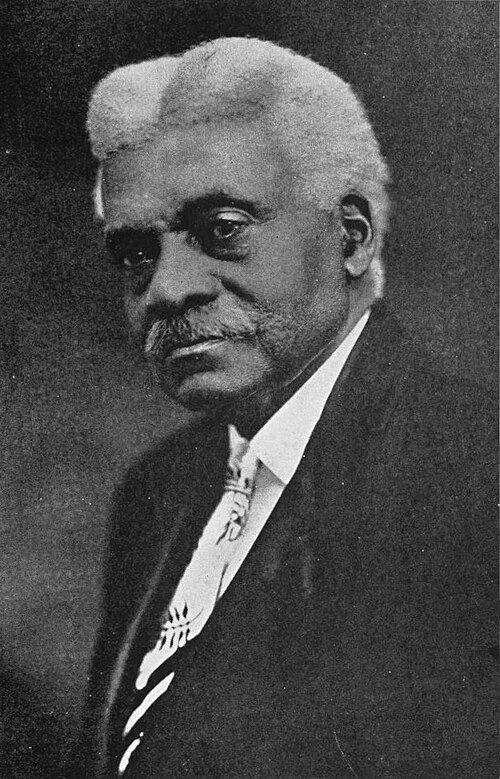
George L. Knox
Photo courtesy of Wikipedia
.jpg)
As the United States marks 250 years, the story of American service cannot be told only through battlefields, presidents, and policy. It must also be told through the lives of those who came home from war and built something lasting.
For generations, veterans have returned from service carrying skills, discipline, resilience, and a sharpened sense of what opportunity can mean. Some built companies. Some created jobs. Some opened doors for others who had been locked out of them. George Levi Knox did all three.
Born enslaved in Tennessee, Knox was forced into the Civil War as the body servant of a Confederate officer before escaping through the lines and serving with Union forces. He emerged from the war free, but nearly penniless and unable to read. What he built from there was extraordinary: a barbershop business, a network of political influence, and ownership of The Indianapolis Freeman, one of the most important Black newspapers of its era.
He began with twenty cents and a carpet bag in a country that had spent his childhood treating him as property. By the end of his life, he had become an entrepreneur, employer, publisher, and power broker.
His story is not only a story of individual grit. It is a reminder of what America has too often required people to overcome alone — and what becomes possible when talent, service, access, and opportunity finally meet.
George Levi Knox (1841-1927)
Born into slavery, both of George’s parents were dead by the time he was six years old. George had an older sister Huldah, and a younger brother Charlie. When their owner died, Knox attributed their favored status as all that kept them from being sold to traders headed south. Instead, the adult children of their former owner divided them between two households. George was often rented out as a day laborer to the many small farms and plantations east of Nashville. Before he was old enough to choose his own future, his labor, movement, and family ties were controlled by others. That context matters. Knox’s later success was not simply a rise from poverty. It was a rise from a system designed to deny him ownership of himself, let alone ownership of a business.
Forced into War
When the Civil War reached Tennessee, George’s master took a 12-month enlistment, and returned home for a time. But the conflict loomed ever closer until, in early 1863, George’s master was recalled, and this time George, now 22, was forced to accompany him.
George first served as the body servant of the Confederacy’s Captain James Phillips, the Commander of Company D of the 8th Tennessee Cavalry. More than 30,000 slaves were forced to serve the Confederacy as body servants during the Civil War. While they were not expected to engage in combat, they handled much of the daily efforts of soldiering, including cooking, cleaning, tending horses, foraging, nursing, gravedigging, and other unpleasant labor.
If a battle lasted more than a couple of hours, body servants were expected to locate their charges on the battlefield to deliver food and drink. Body servants typically waited well behind the front lines with wagons, keeping watch on a soldier’s personal effects. However, some officers had their body servants at their side in battle, and though they were forbidden from carrying weaponry, many were hit by enemy gunfire during the conflict.
Knox’s Civil War experience began not as voluntary service, but as forced labor in support of the Confederacy. That distinction is essential. His later connection to Union forces was not simply a shift in military affiliation. It was part of his passage from enslavement toward freedom.
Escape to Union Lines
In May of 1863, George and his master were given leave to visit home and he engineered his escape. A slave named John Biggles hid George under the floor of his wife’s house for two days, until a near-discovery forced Knox into the field and forest along the property line. He waited almost two weeks until his brother Charles finally caught up to him.
George, Charles, and at least one other man and his uncle traveled on foot, avoiding dogs, bushwhackers, and prying eyes as they journeyed 20 miles to Union forces. They eventually found a Union guard and surrendered to him.
15th and 57th Indiana Infantry
George became a teamster for the Union Army, organizing mules to haul cargo alongside the soldiers. His brother Charles went to the neighboring 57th Infantry camp, where within a few weeks he took ill. He died days later, and George blamed poor nursing care. George began to fear every horror story and rumor he heard about the north was true. In many speeches, he compared his life as a slave favorably to his time with the Union Army.
George would serve many roles in the 15th Indiana Infantry as it marched to Chattanooga, Tennessee. He participated in the fighting there, though removed from the frontline combat. Sick of the hard work of moving wagons and mules, he hired himself to Union Captain John F. Monroe of the 15th Indiana Infantry as a body servant. Three days later, the man died in George’s arms from a gunshot wound sustained during the Battle of Missionary Ridge earlier in the day.
George again sought an officer to hire himself out as a body servant, eventually meeting Lieutenant William G Humphreys of the 57th Indiana Infantry. He marched with the Lieutenant for some time, until moving into the employ of Captain Addison Dunn of the same regiment later. George accompanied Captain Dunn home to Indianapolis, where they parted ways in April of 1864. George was left to navigate a new city and his newfound freedom alone.
Knox was now free, but he was also alone in a new city with no capital, no formal education, and no established path forward.
Twenty cents and a carpet bag
With twenty cents in his pocket and a few meager belongings in a carpet bag, George Knox crossed town and got a job as a yard man in the Bates House Hotel in Indianapolis paying 18 dollars a month. He was soon head porter, and then moved across the street to be the porter at a barbershop, where he earned 7 dollars a day. In 1865, the barbershop went bankrupt, but Knox had saved his money. He went in with the barbers on a new shop in Kokomo, Indiana, and there he learned the barber trade.
Unfortunately, when he returned to Indianapolis in October 1865 to strike out on his own, he got scammed into buying a fraudulent lease at the Spencer House Hotel, which left him dead broke just four weeks before he was to marry Aurilla Harvey. Unwilling to marry without a job, George moved to Greenfield, Indiana, this time with forty cents in his pocket, and opened a new barbershop with a single chair.
He was married to Aurilla a few weeks later. An educated woman, she taught George how to read and write as his business grew. Soon, he moved to a larger location across from the courthouse, and became a fixture in Greenfield for nearly 20 years, mastering his trade and the discussion of politics. Knox forged alliances among Greenfield’s Republican Party and pushed to make church and school more available to Black children of the region.
This was entrepreneurship in its rawest form: no inherited wealth, no formal training, no safety net, and no second chance guaranteed. Knox learned the market by working in it. He learned the trade by practicing it. He learned the cost of a bad deal by losing nearly everything. And then he rebuilt.
Building a Barbershop Enterprise
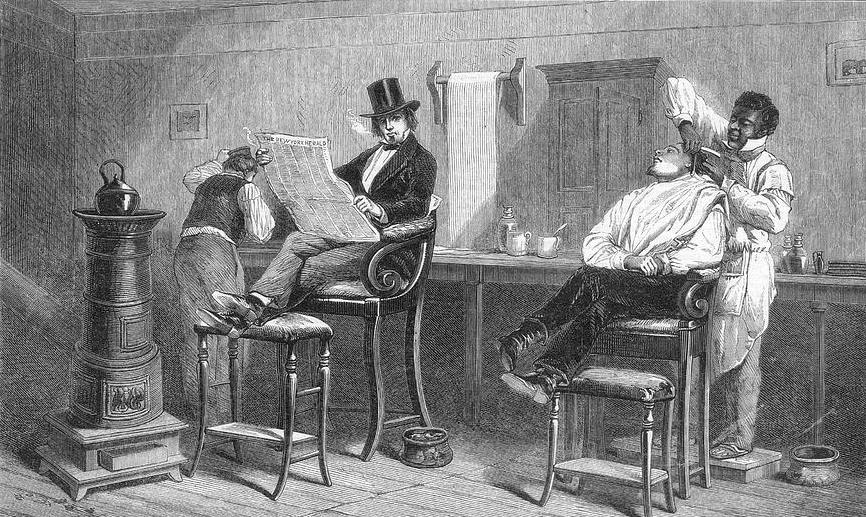
In 1884, Knox moved to Indianapolis and partnered with a well-known local barber to open a barbershop on 11 South Meridian Street, just two blocks from the Indiana Statehouse. It was a immediate success, and within a year he had six full-time barbers in his employ. A year later he opened a second location on his own, leasing space in the Bates House Hotel he once worked in as a porter, a full block closer to the statehouse.
Knox sold a white-glove experience for his clients to rival any barbershop in Chicago or Cincinnati. Not only did he provide haircuts and shaves, but the barbershop sold cigars, a variety of tonics, lotions, and other luxury services. With two successful barbershops fueling his expansion, Knox soon added locations at the Grand Hotel in 1892 and the Denison House not long after. By the mid-1890s he had more than fifty Black employees working for him, though they only served wealthy white clients, among them the future 23rd President of the United States Benjamin Harrison.
That detail captures the complexity of Knox’s life and business. His shops created employment and economic opportunity for Black workers, but they operated within the racial boundaries of the time. Knox built influence in rooms that were not designed for him, often by serving the men who controlled access to power. His strategy was imperfect, complicated, and constrained by the realities of the era. It was also effective.
Buying the Platform
As George Knox’s empire grew, he invested in land, businesses, and banks, including the Black-owned Fidelity Savings and Loan. He also bought up debt. In the early 1890s, Knox held a considerable amount of debt on Edward E. Cooper’s Democratically-aligned Black newspaper, the Freeman.
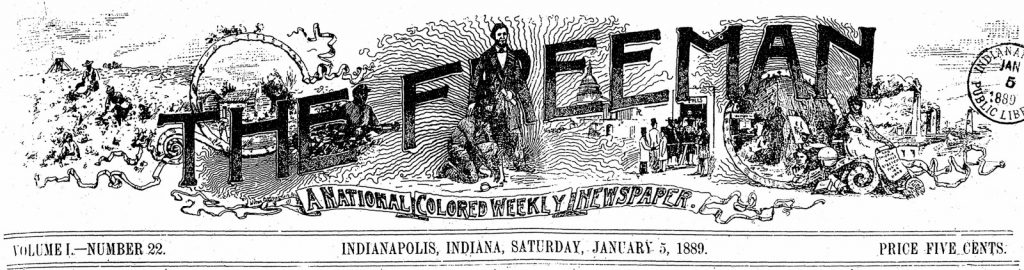
He bought out Cooper and took over the paper in 1892, switching its politics overnight to make the case for Indianapolis’ own Benjamin Harrison’s presidential run. Afterward, Knox wielded the paper’s political influence as a mouthpiece for his own moderate Republican views, largely in line with frequent contributor Booker T. Washington. George was very hands-on, running the paper with his son Elwood, and they quickly expanded readership. Knox took great pride in paying for original content, hiring correspondents to report on Black issues nationwide.
By 1913 the Freeman had a national circulation over 20,000 per issue, and was considered one of the most important news sources for Black Americans. In 1926, the paper went bankrupt. This was due to a variety of market forces, but largely boiled down to stiffer competition in local and national markets, and the dramatically rising costs of paper.
Knox’s political evolution reflected a broader period of uncertainty and transition for Black political power in America. But the core of his story remained consistent: he used business, media, and relationships to push for influence in systems that rarely yielded power willingly.
Baseball Team Owner
In 1887, there were many failed attempts to form a nationwide league for Black baseball players. This was long before the heyday of Rube Foster’s National Negro League of the 1920s, or the twilight years of segregated baseball with Hank Aaron and the Indianapolis Clowns in 1951. In 1890, George Knox owned an amateur team called the Indianapolis Barbers Baseball Club, where his son Elwood (at 19 years old) was the starting pitcher.
It’s not clear if Knox saw ownership of the team as an investment, local prestige, an opportunity to advertise his barbershops, or just wanted to support his son’s dreams. It’s also unclear if George owned multiple teams in the local rec club, or merely supported or sponsored them, but his son also played with the Freemans in 1894 (possibly named for the paper they operated together), and managed the Herculeans for five years after that, very likely associated with the Black Republican social club of the same name.
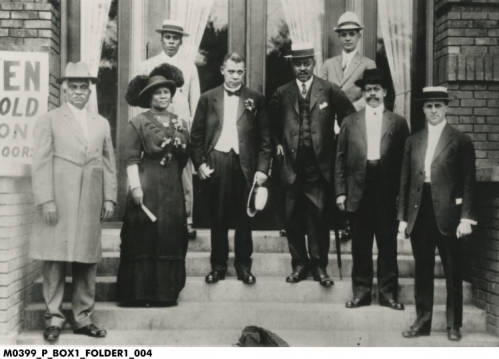
George Knox pictured to the left of Madam C.J. Walker at the dedication of the Senate Ave YMCA. Madam C.J. Walker Collection, Indiana Historical Society
George Knox’s barbershops always served the white, wealthy, political elite. Even back in Greenfield, Knox networked his way into the halls of power within the Republican Party. He took those lessons with him to Indianapolis, and by the early 1890s he was very influential throughout Indiana. While painted by Democrats as a militant radical, Knox was a moderate, and a defender of Booker T. Washington’s Tuskegee Philosophy. That accommodationist approach was criticized by more progressive leaders, including W.E.B. Du Bois, who argued that it constrained the fight for full equality. Knox also faced criticism for operating color-line barbershops that primarily served white men.
The truth is more complicated. George Knox never served as an elected official. So, in many ways, his access to power within the Republican party depended on the good favor of the white men in charge. So, while his strategy of accommodating his white colleagues might read as problematic or inauthentic today, it served as a successful strategy for Knox for most of his life, right up until the early 1900s when it didn’t.
For a moment, George Knox was one of the most important delegates during the 1892 Republican National Convention in Minneapolis. In a legendary marathon of backroom one-on-one debates, Knox convinced other delegates who took issue with Benjamin Harrison’s stance on Black issues to support the Republican incumbent. While Knox returned as a delegate to the 1896 Republican National Convention in St. Louis, his power within the party had already begun to wane.
Switching Parties
Black America Switches Parties
When Black men gained the right to vote in 1870 with the 15th Amendment, most Black voters identified with Lincoln’s Republican Party. Around 1920, (when women also won the vote) the Black vote split over support for Civil Rights Legislation, and many Black Americans were unsure which party to support. However, by 1936, Franklin Delano Roosevelt’s New Deal Coalition solidified the Black voting bloc behind the Democratic Party, where it has predominantly remained to this day.
By the mid-1890s, George Knox found more progressive stances on a variety of issues, calling for an end to interracial marriage bans in 1896. But he remained difficult to pin down politically, as he almost single-handedly killed an Indiana bill to integrate schools a year later. In 1904, Knox tried to primary a white Republican House member in a majority Black district of Indianapolis. Republican bureaucrats killed his candidacy just two weeks before the primary vote. In 1906, Knox spoke out against Republican President Theodore Roosevelt, who ordered wrongfully-accused Black soldiers in Texas dishonorably discharged in the wake of the Brownsville Affair.
In 1907 he even urged Black voters to show their independence in local races across the country. However, it wasn’t until 1924, when the KKK had taken the reins of Indiana Republican politics, that Knox and the Freeman Newspaper endorsed the Democratic Party. Three years later, in August 1927, Knox suffered a fatal paralytic stroke in Kentucky.
The Difference Support Can Make
George Levi Knox built an empire from twenty cents, and almost none of it came easily. He could not read. He had no capital. He had no one to teach him business or steer him clear of a bad deal, which is how a swindler took his first stake and left him broke weeks before his wedding.
He learned the rest by doing and clawed his way back. By the end of his life, he was one of the wealthiest Black men in the country, an employer of dozens, a backer of Black-owned business, and the owner of one of the country’s leading Black newspapers — the kind of platform and patron no one had ever been for him.
That is what makes his story so powerful in America’s 250th year. Knox’s success was extraordinary, but the obstacles he faced should not have had to be.
Today, IVMF’s entrepreneurship programs exist for military-connected entrepreneurs who are building after service. Through education, mentorship, networks, and access to resources, IVMF helps veterans and military spouses move from idea to execution, from isolation to community, and from ambition to sustainable growth.
Knox had to piece together his own education, his own network, his own capital, and his own path to influence. He had to learn, lose, rebuild, and grow without the kind of support that can keep a first venture from collapsing under a bad deal or a closed door.
That is the difference IVMF works to make today. Not by removing the ambition, discipline, or resilience required to build a business, but by ensuring military-connected entrepreneurs do not have to build alone.
George Levi Knox built his future the hard way. Today’s veteran and military spouse entrepreneurs should not have to.