
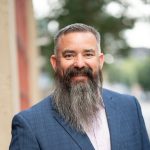
Kevin Rasch
Monte
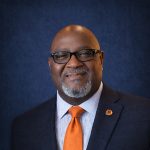
Ken Mayes
July 25th was Hire a Veteran Day, and for a lot of companies that means a flag graphic on LinkedIn and a thank you for your service before lunch. The harder question is “what happens the other 364 days?”
At the D’Aniello Institute for Veterans and Military Families (IVMF), our Onward to Opportunity career training program helps veterans and military spouses obtain professional certifications that open the doors to future careers. Wounded Warrior Project® (WWP) is also a fixture in the veteran hiring space. Their Warriors to Work® program takes a high-touch, one-on-one approach that treats work as an important contributor to veterans’ mental health and financial stability.
We spoke with Kevin Rasch, Regional Director of WWP’s Warriors to Work program, and 22-year Navy veteran and former helicopter pilot, and Jeremy “Monte” Montgomery, a 23-year Air Force veteran who came through IVMF’s Entrepreneurship Bootcamp for Veterans’ Wounded Warrior Project cohort before founding Lean Synergy Solutions, a veteran-focused recruiting firm. Monte is, in a sense, what the system looks like when it works. We also reached out to Ken Mayes, MBA-HRM, SHRM-CP, IVMF’s Employer Relationship Manager at our Onward to Opportunity program, Their answers have been condensed for length.Their answers have been condensed for length.
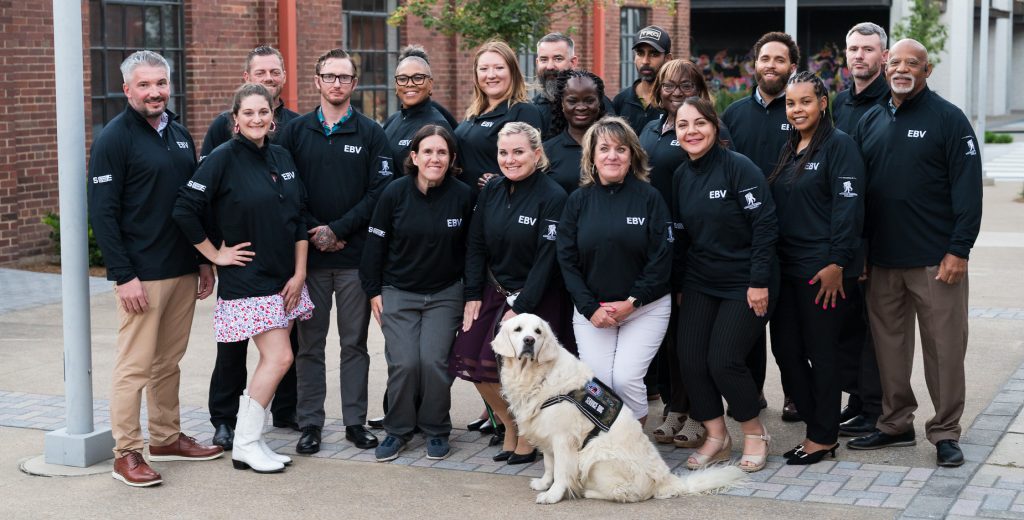
EBV-WWP Nashville Participants
First, the big picture. What does veteran employment actually look like right now?
Kevin Rasch, Wounded Warrior Project: When I started at WWP® almost 12 years ago, we were still having to convince employers of the value of hiring veterans, and the unemployment rate was really high. For the past few years, veteran unemployment has been lower than the national average, and it has been stable. Employers figured out that veterans are valuable. There are probably more employers who want to hire veterans than there are veterans looking for work.
Our job now is to make the match and avoid underemployment, because that is the piece that can still be challenging . It is not always about money. It is quality of life and self-worth, and a lot of people do not realize they are underemployed until someone tells them they could be doing more. Part of our work is about reminding a veteran that they have a choice now, and they can find the best fit for them – they can find something they’re truly passionate about.
Jeremy “Monte” Montgomery, Lean Synergy Solutions: It is a hirer’s market, and the thing I say in every circle I am in is that the market dictates everything. You can be right about your resume, right about your approach, right about the number of applications you send, but if you do not understand what the market is demanding, you are not even shooting at the right targets.
People talk about translating military skills, and that is a piece of it. But it comes down to this. The talent needs to understand what the market wants, and the market needs to understand what is in the talent pool. When that clicks, you have a lot of transitioning service members doing two or three applications and getting an offer. The disconnect is that candidates often do not understand what problem they actually solve, and sometimes the companies do not even know what problem they are trying to hire for.
A lot of job seekers describe firing off hundreds of applications and hearing nothing. Why does that not work, and what does?
Kevin Rasch: It is so easy to apply now. You click apply on LinkedIn, it imports your profile, and you can have almost no skin in the game. Before you know it, you have applied to everything, you are getting your hopes up because it says you are an 86 percent match, and then you hear nothing. People handle good news well, and they handle bad news surprisingly well. It is that no news, the black hole, that causes the stress.
Job boards are good for awareness, but the most effective way to find work is still networking. We push our veterans to build a 30-second elevator pitch and go use it at a networking event, at the grocery store, wherever they are. A warm handoff and someone who can advocate for you beats sitting at home applying, applying, applying. Isolation is one of the biggest things we fight.
Monte: I get a little sick in my mouth when I hear someone applied to 20, 30, 50, 500 jobs. You are engaging the wrong target with the wrong weapon system at the wrong time. The mistake is that veterans hawk their skills when they should be hawking the problems they can solve. It is old-school features and benefits. You can list a thousand features, but if you do not know what actually benefits the buyer…
Corporate America just wants someone to solve a problem so they can make money. So, translate your whole history around what problems you solve, and if you apply somewhere and cannot say out loud what you would solve for them, you do not have enough information yet. Dig further. At my firm that is literally the job, to be the translation piece between the candidate and the company.
It is easy to post a flag on Hire a Veteran Day. What separates the companies that genuinely hire and keep veterans from the ones just making a post?
Kevin Rasch: Every day should be Hire a Veteran Day. The veteran community can tell the difference between the ones who walk the walk and the ones who just talk the talk. Thank you for your service in passing is one thing. Actually hiring, building veteran resource groups, promoting people, that is another. The most successful employer relationships are not just giving back, they are mutually beneficial. And feedback is everything.
Our biggest frustration is the employer who says “send them to our job board” and then goes silent. When a company gives us a point of contact and tells us how a warrior did, even if the answer is no, we can act on it. We talk about living our logo. The warrior in it is being carried off the battlefield, and the goal is to become the one doing the carrying. And we do not stop once someone is hired. We follow up, we check in, we are here, with you,for a lifetime.
Monte: I have been in this six years, hundreds of companies, tens of thousands of resumes, here and abroad, and it comes down to one thing. It is all lip service unless a company makes a real effort to understand the talent pool and help their own people translate what veterans and military spouses bring. I have seen companies with beautiful veteran pages, veteran reps, huge logos, and they do not know a damn thing about what they are actually trying to do for the veteran community.
The difference is the organizations that go past the post and build a real program, that teach their internal hiring people how to understand the military, how to onboard and retain them, and how to translate that experience instead of being afraid of it. Fighting for a candidate sounds like, “I know he is missing this one box, but here is where he fills every other gap, and his learning curve is going to be shorter than anyone else’s.”
Ken Mayes: Supporting veteran talent requires commitment from both workforce development programs and employers. O2O helps military-affiliated job seekers earn industry-recognized certifications by connecting them with vetted training providers, certification organizations, career coaching, and peer mentorship.
WWP and IVMF have both worked toward veteran employment through career planning programs and even entrepreneurship. How do the two organizations work together? And Monte, you came through the Entrepreneurship Bootcamp for Veterans: Wounded Warrior Project, a joint IVMF and WWP program. What did it give you?
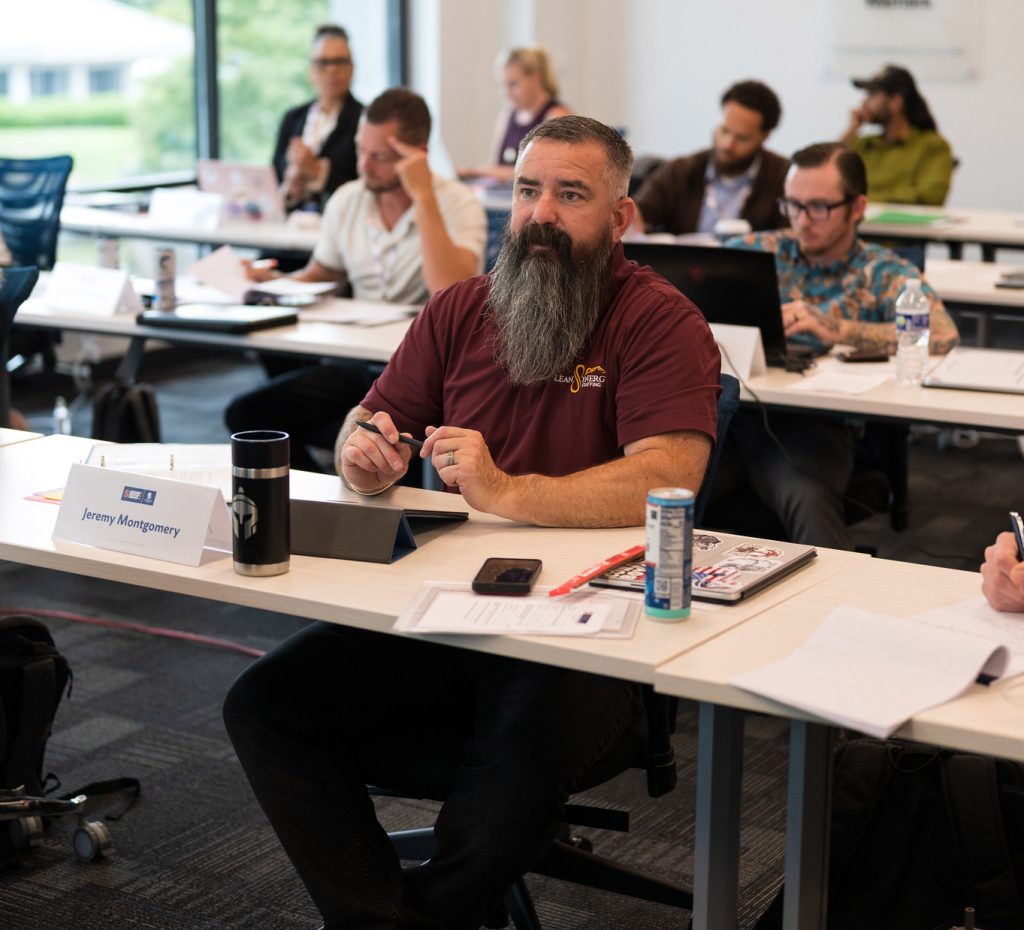
Monte attending class for WWP EBV.
Monte: I did the joint Entrepreneurship Bootcamp for Veterans (EBV) through WWP and IVMF right around the time I was launching my current company. As an entrepreneur you are a dreamer first. You have the vision and you just start executing, which is not bad, we need people like that. What that program did was slow me down. It walked me through the parts of a business I had not even thought about, banking, accounting, insurance, legal, marketing, all of it. I realized I had gaps that were not just weak, they were nonexistent.
It grounded me. It gave me pillars to build on, and even where a pillar was weak, at least I knew it was supposed to be there. I also run MilCruit, a community of veterans who now sit in hiring and recruiting roles, and the whole idea is that if I cannot help someone, I hand them to someone in the network who can.
Kevin Rasch: We know no one organization can do this alone, so we are very collaborative in this space. We are not in competition with each other. It is all about what is best for that veteran in transition. For example, when I started at WWP, I ran an IT training program teaching basic certifications. It went away, because IVMF’s Onward to Opportunity was offering a much broader, more developed set of certifications. So, we pulled back, focused on the employment side, and that certification-based training became an enabler for the veterans we serve. There are a lot of great organizations doing great work, and we’re proud to partner with them.
Ken Mayes: During my tenure as an O2O program manager and employer relationship manager, I can attest that the most effective employers take a long-term approach to veteran hiring. They do more than recruit veterans; they create environments that support career growth, professional development, and retention. Organizations that consistently attract and retain veteran talent recognize military experience as a competitive talent pipeline and invest in structures that support success throughout the employee lifecycle.
Last one. What is the one thing you wish more employers understood, and one thing you wish more veterans knew?
Kevin Rasch: For employers, the value of a veteran is not just the hard skills. It is the soft skills, the motivation, the ability to perform under pressure, and there is no real substitute for that. Do not assume an infantry background only leads to security or law enforcement. The range is much wider. For veterans, open your minds. You do not have to keep doing what you did in uniform. Getting out is one of those rare inflection points where you can reinvent yourself, and there are training programs and entrepreneurial paths to do it. You don’t have to do it alone.
Monte: This might be a little out of the ordinary, but employers need to learn how to hire. I sit in on interviews and the questions are boring and generic and do not pull out anyone’s real talents. Ask better questions. Find out what is at the core of the person in front of you, and what problem you actually need solved.
When hiring managers do that, veterans and military spouses shine, because they can tell you about solving problems in austere environments, under time pressure, with a team from every walk of life. Corporate America struggles to hire well, and a lot of that is fear, because nobody taught them how. Fix that, and all this talk about sending out 200 applications drops off a cliff.
Helping Veterans Find Great Careers
Hiring a veteran well takes more than a day. It takes employers willing to learn, veterans willing to reintroduce themselves, and organizations willing to work together to close the gap. That is the work IVMF and WWP are doing year-round with programs like Onward to Opportunity, Warriors to Work®, and Entrepreneurship Bootcamp for Veterans.