
Overview
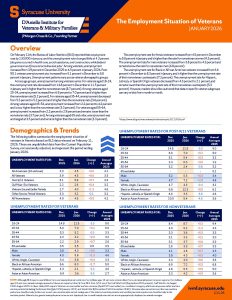
On February 11th, the Bureau of Labor Statistics (BLS) reported that employment rose by 130,000 in January, and the unemployment rate changed little at 4.3 percent. Job gains occurred in health care, social assistance, and construction, while federal government and financial activities lost jobs.[1] Among veterans, unemployment increased from 3.9 percent in December 2025 to 4.5 percent in January 2026. Post-9/11 veteran unemployment also increased from 5.1 percent in December to 5.8 percent in January. Unemployment patterns vary across veteran demographic groups.
Across age groups, unemployment among veterans varies. For veterans aged 18–24, the unemployment rate decreased from 14.8 percent in December to 11.5 percent in January and is higher than the nonveteran rate (8.7 percent). Among veterans aged 25–34, unemployment increased from 6.9 percent to 7.0 percent and is higher than the nonveteran rate (5.2 percent). For veterans aged 35–44, unemployment decreased from 5.3 percent to 5.2 percent and is higher than the nonveteran rate (3.6 percent). Among veterans aged 45–54, unemployment increased from 2.2 percent to 4.2 percent and is now higher than the nonveteran rate (3.3 percent). For veterans aged 55–64, unemployment increased from 2.2 percent to 2.9 percent and remains lower than the nonveteran rate (3.7 percent). Among veterans aged 65 and older, unemployment was unchanged at 3.5 percent and remains higher than the nonveteran rate (3.3 percent).
The unemployment rate for female veterans increased from 4.5 percent in December to 5.8 percent in January and is higher than the rate for nonveteran women (4.3 percent). The unemployment rate for male veterans increased from 3.8 percent to 4.3 percent and remains below the rate for nonveteran men (4.8 percent).
The unemployment rate for Black or African American veterans increased from 6.6 percent in December to 8.3 percent in January, and is higher than the unemployment rate of their nonveteran counterparts (7.2 percent). The unemployment rate for Hispanic, Latino/a, or Spanish Origin veterans decreased from 4.3 percent to 2.1 percent, and remains lower than the unemployment rate of their nonveteran counterparts (5.3 percent). However, readers should be cautioned that data on specific veteran subgroups can vary widely from month to month.
Demographics & Trends
The following tables summarize the employment situation of veterans in America based on BLS data released on February 11, 2026. These are unpublished data from the Current Population Survey, not seasonally adjusted, and represent the period ending January 2026.
| UNEMPLOYMENT RATES FOR: | December 2025 | January
2026 |
CHANGE (+/-) | Annual Averages 2025 |
| All Americans (18 and over) | 3.9 | 4.5 | +0.6 | 4.1 |
| All Veterans | 3.9 | 4.5 | +0.6 | 3.5 |
| Post-9/11 Veterans | 5.1 | 5.8 | +0.7 | 3.6 |
| Gulf-War I Era Veterans | 2.2 | 2.6 | +0.4 | 3.2 |
| Vietnam Era and Earlier Periods | 2.7 | 4.0 | +1.3 | 4.6 |
| Other service period veterans | 3.3 | 3.2 | -0.1 | 3.2 |
| All Nonveterans | 4.0 | 4.5 | +0.5 | 4.2 |
| UNEMPLOYMENT RATES FOR VETERANS | ||||
| Demographic Category | December 2025 | January 2026 | CHANGE (+/-) | Annual Averages 2025 |
| 18–24 | 14.8 | 11.5 | -3.3 | 9.0 |
| 25-34 | 6.9 | 7.0 | +0.1 | 5.0 |
| 35-44 | 5.3 | 5.2 | -0.1 | 3.3 |
| 45-54 | 2.2 | 4.2 | +2.0 | 3.2 |
| 55-64 | 2.2 | 2.9 | +0.7 | 2.6 |
| 65 and older | 3.5 | 3.5 | 0.0 | 3.9 |
|
|
|
|
|
|
| Male | 3.8 | 4.3 | +0.5 | 3.3 |
| Female | 4.5 | 5.8 | +1.3 | 4.6 |
|
|
|
|
|
|
| White, Anglo, Caucasian | 3.4 | 3.8 | +0.4 | 3.3 |
| Black or African American | 6.6 | 8.3 | +1.7 | 5.0 |
| Hispanic, Latino/a, or Spanish Origin | 4.3 | 2.1 | -2.2 | 4.0 |
| Asian or Asian American | 6.9 | 3.6 | -3.3 | 2.7 |
| UNEMPLOYMENT RATES FOR POST-9/11 VETERANS | ||||
| Demographic Category | December 2025 | January 2026 | CHANGE (+/-) | Annual Averages 2025 |
| 18–24 | 14.8 | 11.5 | -3.3 | 9.0 |
| 25-34 | 6.9 | 7.0 | +0.1 | 5.0 |
| 35-44 | 5.1 | 5.4 | +0.3 | 3.3 |
| 45-54 | 2.4 | 6.3 | +3.9 | 1.9 |
| 55-64 | 3.2 | 2.4 | -0.8 | 3.2 |
| 65 and older | – | – | – | 0.2 |
|
|
|
|
|
|
| Male | 5.2 | 5.5 | +0.3 | 3.4 |
| Female | 4.7 | 7.2 | +2.5 | 4.8 |
|
|
|
|
|
|
| White, Anglo, Caucasian | 4.7 | 4.3 | -0.4 | 3.2 |
| Black or African American | 6.8 | 12.3 | +5.5 | 6.1 |
| Hispanic, Latino/a, or Spanish Origin | 6.9 | 3.3 | -3.6 | 4.6 |
| Asian or Asian American | 10.0 | 5.4 | -4.6 | 3.6 |
| UNEMPLOYMENT RATES FOR NONVETERANS | ||||
| Demographic Category | December 2025 | January 2026 | CHANGE (+/-) | Annual Averages 2025 |
| 18–24 | 8.4 | 8.7 | +0.3 | 9.4 |
| 25-34 | 4.0 | 5.2 | +1.2 | 4.3 |
| 35-44 | 3.3 | 3.6 | +0.3 | 3.3 |
| 45-54 | 3.1 | 3.3 | +0.2 | 3.0 |
| 55-64 | 3.1 | 3.7 | +0.6 | 2.9 |
| 65 and older | 2.6 | 3.3 | +0.7 | 3.3 |
|
|
|
|
|
|
| Male | 4.1 | 4.8 | +0.7 | 4.3 |
| Female | 3.8 | 4.3 | +0.5 | 4.0 |
|
|
|
|
|
|
| White, Anglo, Caucasian | 3.4 | 4.0 | +0.6 | 3.6 |
| Black or African American | 6.9 | 7.2 | +0.3 | 6.8 |
| Hispanic, Latino/a, or Spanish Origin | 4.8 | 5.3 | +0.5 | 5.0 |
| Asian or Asian American | 3.3 | 4.2 | +0.9 | 3.6 |
NOTE: Although BLS reports overall labor force and unemployment estimates for civilians ages 16 and over, veteran labor force and unemployment rates are reported for civilians ages 18 and over; annual averages presented above are reported directly from BLS. Post-9/11 are of the Gulf War Era II (September 2001-present). Gulf War Era I is August 1990-August 2001. In these tables, BLS reports Vietnam-era and earlier wartime veterans (April 1975 and earlier) as a combined category, which encompasses earlier wartime service periods (including the Korean War [July 1950-January 1955] and World War II [December 1941-December 1946]). Veterans who served in more than one wartime period are classified only in the most recent one; veterans who served during one of the selected wartime periods and another peacetime period are classified only in the wartime period. Minority-by-gender unemployment rates are not displayed due to small sample size and are more appropriately displayed as annual averages.
[1] https://www.bls.gov/news.release/archives/empsit_02112026.pdf