The Career You Never See

Military Spouse Employment

Always Adapting. Rarely Advancing.


Half a million active-duty military spouses navigate a system that treats their careers as expendable. They earn 42% less than their civilian peers. They face unemployment rates nearly four times the civilian average. They relocate 3.6 times more often than civilian families, resetting careers with every move. These are not personal failures. They are the predictable outcomes of a system that was never designed to account for their careers and financial stability.

The problem does not start in one place or end in one place. It begins with invisible labor that never appears on a resume. It accelerates through PCS-driven career resets that erase seniority, salary, and momentum. It compounds through childcare costs that exceed what the job market will pay. It follows military families past transition, eroding retirement savings, reducing Social Security contributions, and shrinking lifetime earnings long after the uniform comes off.

Military spouses are not falling behind. They are being held back.

This is the career you never see.

The Career You Never See


Military spouse employment is the number one issue facing active-duty families, cited by 50% of respondents in IVMF’s 2025 MFLS*. It affects recruitment, retention, and long-term financial stability. Seventy-seven percent of active-duty family respondents in the 2025 MFLS said that support of military families during service strongly impacts future recruitment. Only 37% would recommend a family member join the military.

Stage 1

Invisible labor, hidden costs

Military spouses manage households through deployments, coordinate cross-country relocations, provide unpaid caregiving, and volunteer at nearly double the civilian rate. None of this appears on a resume. None of it generates a paycheck.

Learn More

Woman hugging man in wheelchair.

A sad daughter sitting as her parent unpack boxing from moving.

Stage 2

Always starting over

Active-duty families relocate 3.6 times more often than civilians (USAA*). Each move costs a military spouse an average of $14,571 in lost annual income and time spent job hunting. The PCS cycle resets careers every few years, asking spouses to figure it out with little support.

Learn More

Stage 3

Childcare isn’t a choice

Military spouses with children aren’t opting out of the workforce so much as being pushed out. The cost of care exceeds the wages they can earn, and the care itself often does not exist near their installation. Childcare is workforce infrastructure. For military families, that infrastructure is failing.

Learn More

Military spouse watching her husband in uniform hugging their kids

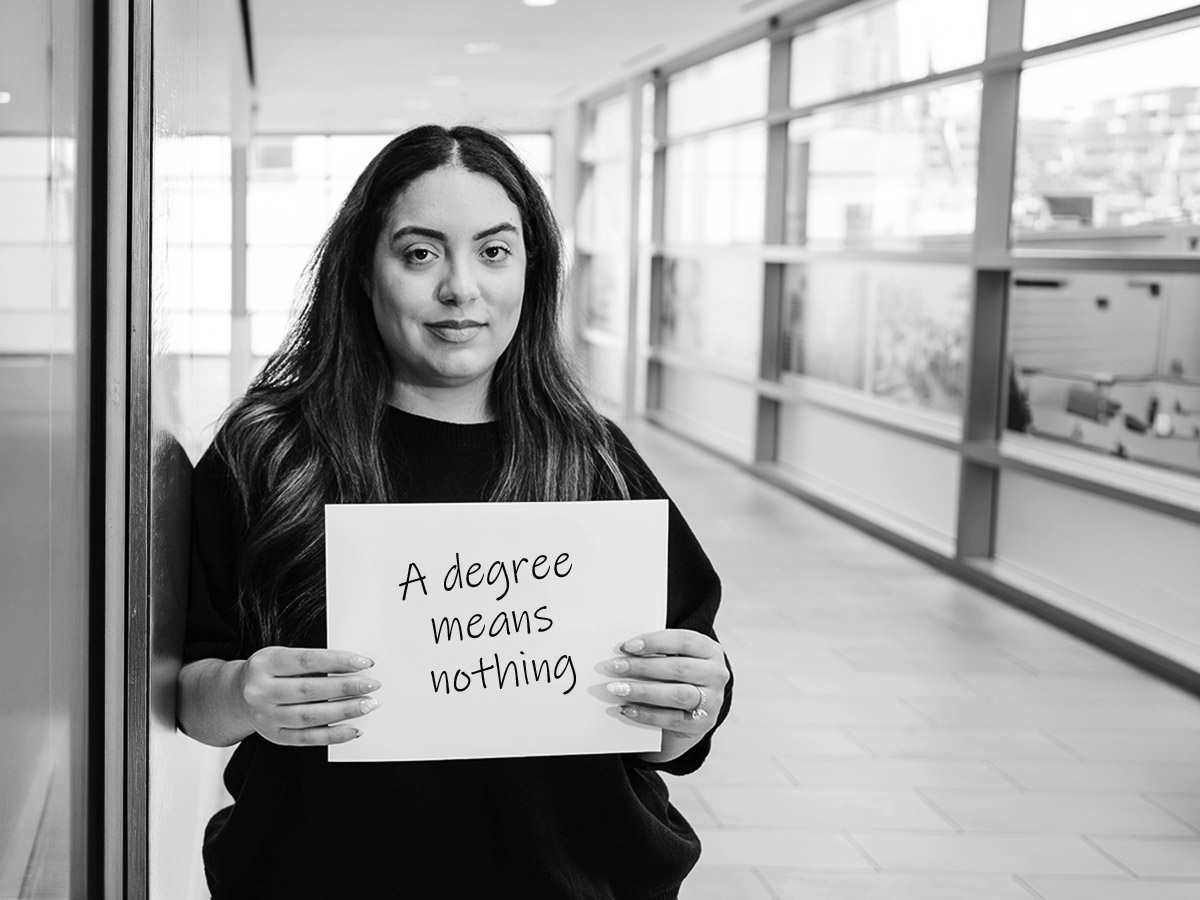
Cardboard sign that says "Degrees mean nothing"

Stage 4

Same education, half the pay

Military spouses hold degrees at rates that exceed the civilian average, but earn 42% less (USAA*). Education is not the problem. The system suppresses their ability to find work in their field.

Learn more

Stage 5

The long game

Career disruptions during service do not end at transition. They compound into retirement savings gaps, reduced Social Security contributions, and diminished lifetime earnings. The career disruptions documented in every earlier stage do not resolve on their own. They accumulate.

Learn More

Uniformed man standing in front of woman - only show their legs.

The Data Behind The Struggle


The D’aniello Institute for Veterans and Military Families (IVMF) has been gathering data to understand the complex web of unique obstacles and challenges facing our nation’s military spouses for years, informing our suite of programs and initiatives to better serve them. IVMF has discovered a pattern of structural and institutional failings in the economic opportunities facing military spouses, and is bringing awareness to The Career You Never See.

Browse The Data Yourself

As IVMF has continued to explore issues facing military spouses, three signature pieces of research have been especially informative. We’ve made the research publicly available for you to browse here:

2024 Military Family Lifestyle Survey

2025 Military Family Lifestyle Survey

2025 IVMF/USAA Employment Landscape

Military spouses are professionals, entrepreneurs, caregivers, and community leaders. They hold bachelor’s degrees at significantly higher rates than the civilian population, 30% vs. 24% (USAA). They build careers, start businesses, and manage households through conditions that would stall most workers permanently. Their work, their talent, and their economic contributions remain invisible to the systems that should support them. The data proves what military families already know. The career is real. The system refuses to see it.

Vanessa and Ryan Marquette

Military Family Employment Challenges

Wage Gap
42%
Less earned than civilian peers
Mobility Rate
3.6×
More moves than civilians
Unemployment Rate
Higher than civilian spouses

Employment Barriers — MFLS 2025
Finding it difficult or just getting by financially
27%
Overqualified for current role
37%
Takes 3+ months to find work after moving
39%
Not employed due to childcare costs
64%

Military Spouse Voices


Rosseane Zingerman

After an 8-year career pause to focus on motherhood and the unique demands of military life, I decided to get my professional path back and break into cybersecurity… O2O has been an important part of this journey. The online courses and exam simulator helped refresh my technical skills. It restored my confidence as I prepared for certification. This program gave me the structure I needed to stay on track and the flexibility to learn at my own pace, which is crucial for a military spouse balancing family responsibilities. Beyond the technical training, O2O connected me to a supportive network of mentors and peers who generously shared their insights, guidance, and encouragement.

Rosseane Zingerman

Spouse | ITIL® V3 Foundation Certified

Beverly Cutchins

Being a military spouse, I forfeited my career’s stability to support my spouse’s military tenure. Previously, I had sought out certifications to strengthen my position in the job market but was unable to pay for all of the resources required. Classes for PDUs (Professional Development Unit), textbooks and study material, and the test voucher itself. It’s hard to improve yourself when you are currently unemployed, and cost is the biggest barrier. Thankfully, O2O covered all of the cost and even included one year of professional membership with PMI–something I also could not have afforded at this time.

Beverly Cutchins

Spouse | PMP Certified

Soo Hyun Jeong

As a military spouse and a retired member of the Republic of Korea Navy, I faced immense uncertainty when I moved across the Pacific after getting married. My entire adult life had been in uniform, and I struggled to see how my skills and achievements would translate in the U.S. job market. I wasn’t hopeful about starting a new career—until I found O2O. Discovering the O2O program changed everything for me. O2O is more than a training program. It’s a lifeline for military spouses who are unsure of their next step. It’s a source of confidence, empowerment, and possibility. To any spouse feeling uncertain about re-entering the workforce, I want you to know that O2O can help you reclaim your professional identity.

Soo Hyun Jeong

Spouse | SPHR Certified

Invisible labor, hidden costs


Military spouses perform labor that never appears on a resume and never generates a paycheck. They manage households through deployments, coordinate relocations, navigate military bureaucracy, provide unpaid caregiving, and volunteer in their communities at nearly double the civilian rate, according to the 2025 MFLS. Eighteen percent of active-duty family respondents in the 2025 MFLS identified as unpaid caregivers. Of those, 72% provide care for a child.

The many “behind the scenes” efforts of military spouses directly sustain military readiness, yet no system tracks it, compensates it, or translates it into career credentials. The result is a resume that looks empty and an employment history full of gaps that are not gaps at all. They are evidence of a career the system isn’t counting or crediting.

Always starting over


Active-duty military families relocate 3.6 times more often than civilian families (USAA). Each move costs a spouse an average of $14,571 in lost annual income. The 2025 MFLS found that 39% of spouses take three or more months to find work after a PCS, and many never regain the seniority, salary, or professional momentum they had built at their previous employment.

Entrepreneurship and remote work have emerged as responses to this structural problem. While they offer portability that traditional employment cannot match, they are workarounds, not fixes. The PCS cycle remains the single most disruptive force in military spouse careers, and no amount of individual effort and adaptation can overcome a system that resets career progress every two to three years.

Childcare isn’t a choice


64% of unemployed military spouses cited childcare costs as a primary reason they are not working in the 2025 MFLS. Another 67% cite long waitlists or a complete lack of available spaces. For military families, childcare is not a personal preference. It is workforce infrastructure, and it is failing.

86% of active-duty families in the 2025 MFLS identified high childcare costs as a challenge. 41% spend 20% or more of their monthly income on care. When the math does not work, spouses leave the labor force. Not because they choose to, but because the system offers no viable alternative. Childcare near military installations is a national readiness problem, not a family problem.

Same education, half the pay


Military spouses are more educated than their civilian peers on average, yet they earn 42% less (USAA). The 2025 MFLS found that 70% of employed active-duty spouses experience some form of underemployment, and 37% are overqualified for their current roles. The wage gap widens with education. Active-duty spouses with a bachelor’s degree earn a median of $40,000, compared to $74,000 for civilian spouses with the same credential (USAA).

This is not a pipeline problem, military spouses have the credentials. The system suppresses their ability to use them. Licensing barriers, employer skepticism, and PCS-driven career resets ensure that education alone cannot close the gap.

The long game


Career disruptions during military service do not resolve at transition. They compound. Worse, 74% of veteran families who transitioned in the last ten years needed caregiving resources but did not receive them.

These disruptions do not exist in isolation, they are chapters in a longer story of cumulative loss. Suppressed wages, interrupted retirement savings, reduced Social Security contributions, and diminished career trajectories follow military spouses long after the uniform comes off. The career cost of military life keeps taking long after the uniform is put away for the last time.

The career you never see


Military spouse employment is a systemic failure with measurable costs to families, military readiness, and the national economy. The data makes that clear. IVMF’s Onward to Opportunity (O2O) career training and portfolio of entrepreneurship programs create pathways over these barriers, but pathways alone are not enough. The system that creates these barriers must change.

What Was Your Military Spouse Experience?


How have you dealt with the systemic challenges and barriers facing military spouses? IVMF wants to know what got you through your toughest PCS moves, childcare arrangements, job hunts, and more. Help us shed more light on everything military spouses go through by contributing to our military spouse survey. Help us improve support, resources, and policies aimed at leveling the playing field for military spouses, and share your story with us today.

Share Your Story

The Career You Never See is an IVMF campaign examining military spouse employment through multiple converging research streams: the 2025 Military Family Lifestyle Survey conducted by Blue Star Families in partnership with IVMF, the IVMF/USAA Employment Landscape Brief, and IVMF’s longitudinal program outcome data.

For interview requests, embargoed materials, or campaign assets, contact: Lynsey Riffle, Director of Marketing and Communications, lriffle@syr.edu